

AI Overviews and generative answers are reshaping search. If you’re wondering whether your traditional SEO is suddenly obsolete – or if you now have to do double the work – you’re asking a question that plenty of smart teams are wrestling with right now.
The good news is, AI SEO adds a new layer to organic search; it doesn’t replace the foundation. The same fundamentals you already value, like clean structure, clear answers, and strong schema, are what allow you to be cited in AI panels and assistants.
“A lot of those standard best practices around building great content really do apply in the AI age.”
– Robby Stein, VP of Product for Google Search (Source: Google’s AI Search Expert Interview)
This guide shows you how to apply one workflow across content creation, technical SEO, tools, and measurement, so you can increase visibility on both classic SERPs and AI surfaces without doubling effort.
What AI SEO really is
AI SEO is the practice of using artificial intelligence – machine learning and natural language processing – to improve and automate core search engine optimization tasks.
In 2023, nearly half of digital marketers said AI would have a positive impact on website search traffic. This wasn’t optimism talking. AI brings together two critical advantages:
- Speed: AI automates repetitive tasks like keyword clustering and technical audits.
- Insight: AI spots patterns in your data long before a human ever could.
You already know the four big pillars of SEO: On-page, Off-page, Technical, and Local. AI SEO is an added layer that makes each of these pillars stronger. It’s the difference between pushing through tasks manually and working with tech that helps you move faster and with far more precision.
Can SEO be done by AI?
SEO tasks can be assisted by AI, but strategy, experience, and quality control remain distinctly human. Google’s stance is clear: AI-generated content isn’t inherently bad. What matters is whether the said content is helpful, accurate, and serves user intent, regardless of how it’s created.
The most effective approach to achieve this is “AI-assisted human content.” You use AI to handle roughly 30% of your repetitive tasks, like keyword research, initial drafts, and technical analysis, but ensure you still provide:
- Strategic direction and creative insights.
- E-E-A-T signals (real experience, case studies, unique perspectives).
- Quality control and fact-checking.
This balanced approach lets you harness AI’s efficiency while maintaining the authenticity and expertise that both Google and users value.
Step 1. Create AI-assisted content
Conduct AI-assisted keyword research
Traditional keyword research focused on single terms. Today’s AI-powered search demands more conversational, intent-driven queries. Here’s how to modernize your approach:
- For broad ideas: Fire up generative AI chatbots like ChatGPT, Gemini, or Claude. Ask them to brainstorm topic variations and semantic categories around your core subject. They excel at uncovering angles you might miss.
- For specific questions: Your audience asks questions in natural language. Capture these by:
- Mining “People Also Ask” boxes directly in Google.
- Using specialist tools like AlsoAsked or AnswerThePublic.
- Search Reddit and other forums to find the long-tail, conversational queries that signal clear intent.
- For competitor gaps: Use “Content Gap” or “Keyword Gap” features in platforms like Semrush. These reveal what your competitors rank for that you don’t, giving instant opportunities for content expansion.
Enhance content with AI without losing your voice
AI can speed up your content workflow, but it can’t replicate your hard-won perspective. The sweet spot is using it with intention.
Start with AI drafts for the simple, factual bits – definitions, FAQs, product specs. Tools like ChatGPT are great at getting those foundations down fast.
The non-negotiable human step: don’t hit publish on raw AI output. Instead:
- Bring in your real-world examples and case studies.
- Layer in your opinions and lived insights.
- Add any proprietary data that only you can offer.
- Double-check facts and fix inaccuracies.
That human layer is what builds E-E-A-T and turns something generic into something worth reading.
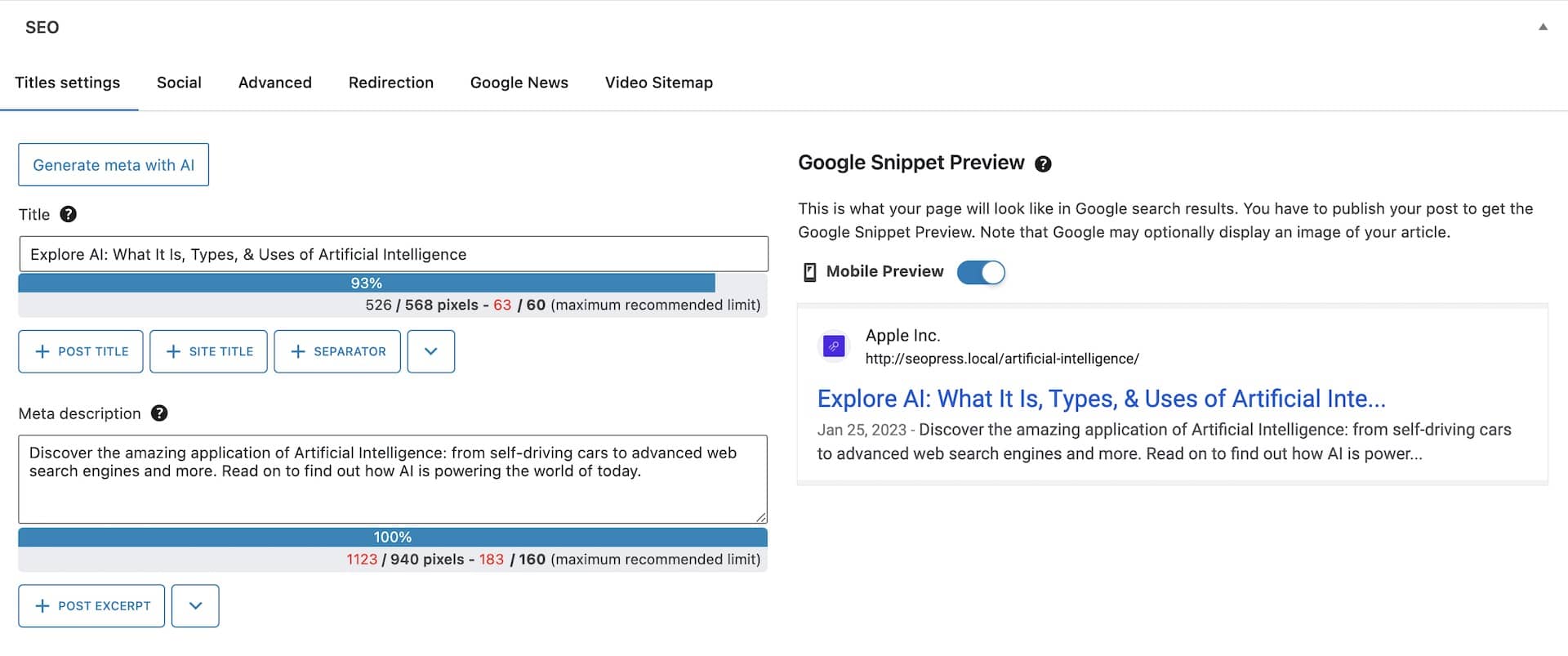
The SEOPress advantage: After you’ve sharpened your content with your expertise, SEOPress AI can help you craft standout titles and meta descriptions. It reads your improved content and recommends SEO elements that spotlight its unique value, without ever leaving WordPress.
Structure content for readability and topic coverage
Clear structure is fundamental to how humans and search engines actually make sense of what you’re saying. When you nail this, everyone wins.
Use descriptive headings that leave no mystery about what each section covers. Your H2s and H3s should create a clean hierarchy that lets readers skim without squinting.
Deploy lists with intent, including:
- Numbered lists for step-by-step processes.
- Bulleted lists for features, benefits, or examples.
Both formats keep things tighter, clearer, and far easier to digest.
Write with clarity and purpose. Each paragraph should pull its weight and deliver exactly what the user came for. Trim the padding, skip the filler, and get to the good stuff fast.
Step 2. Automate technical SEO
Great content is your foundation. But without the right technical signals, neither Google nor AI systems will recognize its value. Technical SEO is the bridge between your E-E-A-T content and the crawlers that need to understand it.
The most important signal: Structured data (schema)
Schema markup explicitly tells Google and AI what your content represents, whether it’s an Article, FAQ, Product, or Local Business. This is about being understood by machines that generate answers.
For most WordPress users, implementing schema is a major pain point. SEOPress PRO eliminates this friction with both automatic and manual schema options:
- The FAQ schema, even though it is being abandoned by Google due to abuse.
- Article schema programmatically communicates your E-E-A-T signals to Google.
- Both formats make your content more likely to be cited in AI Overviews, which are a core component of Generative Engine Optimization.
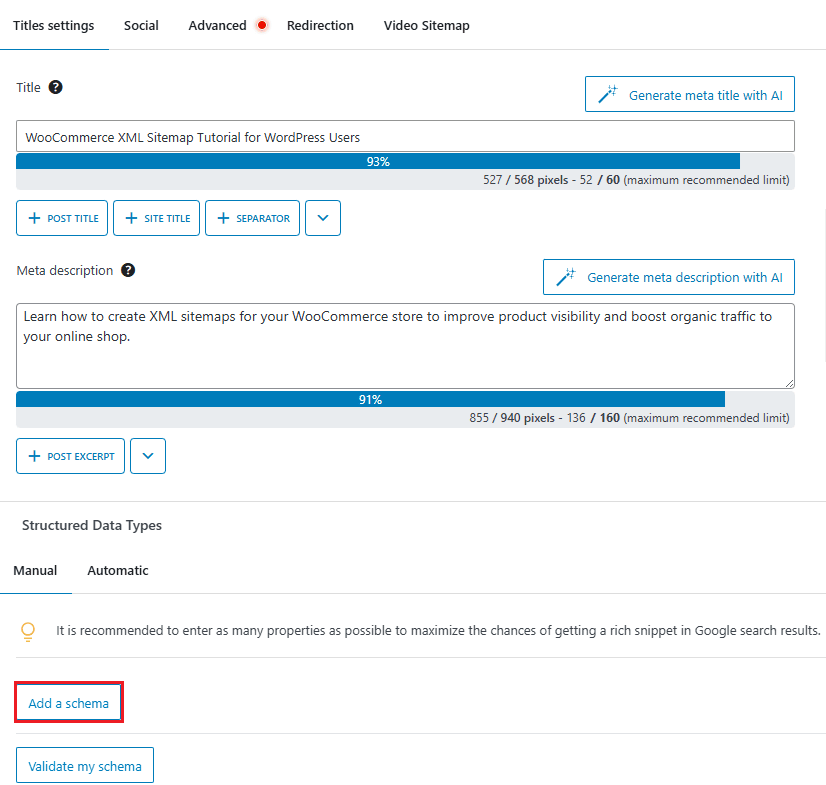
The beauty of this is you’re killing two birds with one stone: improving traditional visibility while preparing for AI-powered search.
Ensure your site is crawlable and healthy
Check your robots.txt
Your robots.txt file acts as a “welcome sign” for bots, but you might be accidentally turning away important visitors. AI crawlers need access to understand and potentially cite your content.
Here’s what a block rule looks like for PerplexityBot (Perplexity AI):
User-agent: PerplexityBot
Disallow: /
Other common AI crawlers to consider include:
- GPTBot (OpenAI).
- ClaudeBot (Anthropic).
Getting a thorough understanding of how to manage your robots.txt is critical.
Fix core site health issues
Permission is just the start. AI and Google favor sites that are technically sound – fast, functional, and free of errors. Ensuring you’ve got a site in tip-top shape is paramount.
Here are the critical issues to address:
- Broken links that frustrate users and waste crawl budget.
- Slow images that hurt performance scores.
- Duplicate content issues requiring proper canonicals.
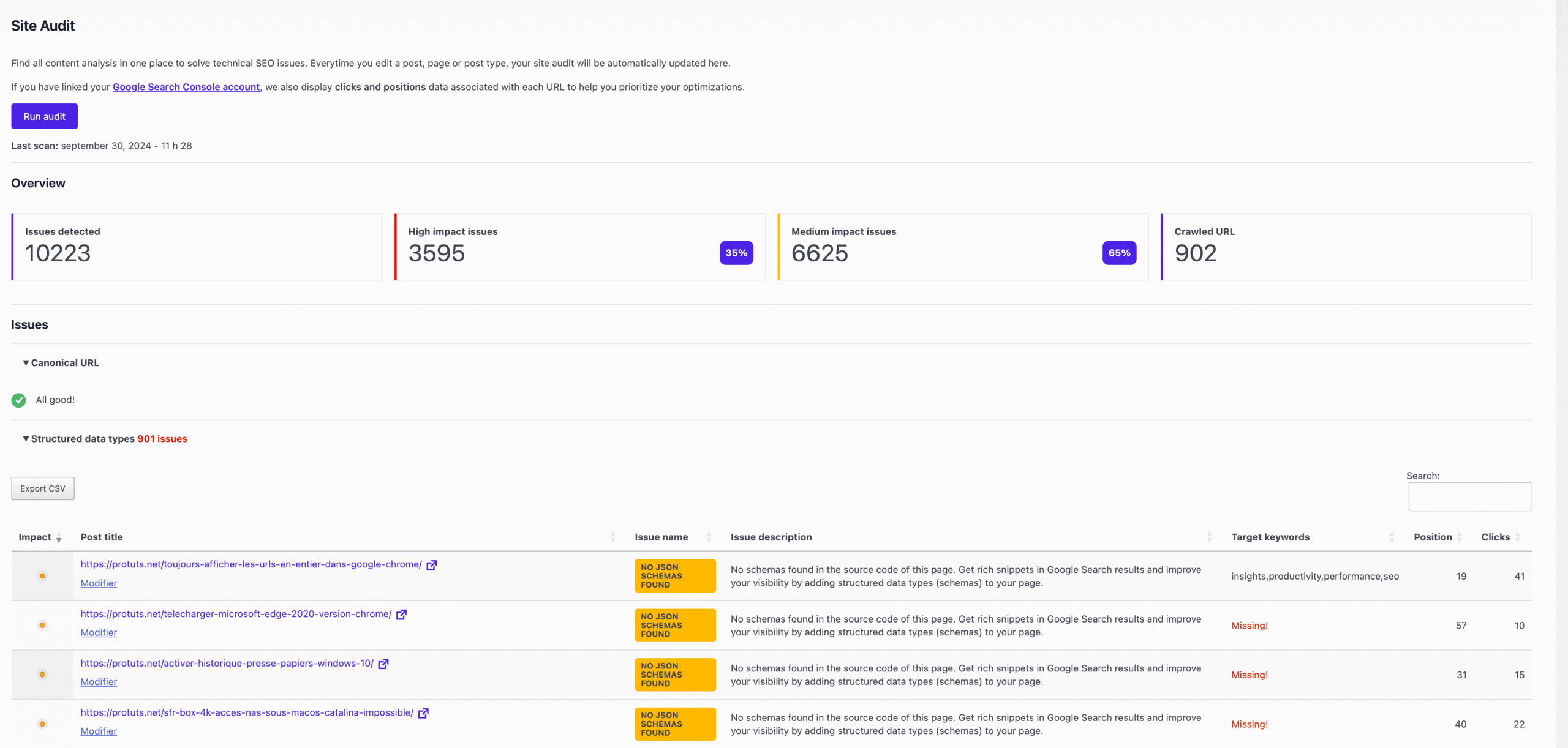
SEOPress PRO streamlines this entire process. The Site Audit feature automatically identifies crawl errors, image problems, and other technical issues. Then, the built-in Redirection manager helps you fix broken links and handle 404 errors, all from your WordPress dashboard. No need for multiple tools or technical expertise.
Step 3. Choose your AI SEO tools
It’s easy to feel overwhelmed by the sheer number of AI SEO tools available. The market is flooded with powerful – and often expensive – specialist solutions, each promising to revolutionize your workflow.
But the real issue is the fragmented workflow they create. Most AI tools create an inefficient reality that pulls you away from WordPress:
- Ideation tools like ChatGPT excel at brainstorming, but you’re copying and pasting between browser tabs.
- Standalone AI writers such as Koala AI generate solid first drafts, but in their own interface, disconnected from your site.
- Single-page optimizers like Surfer SEO offer valuable suggestions, but require you to analyze content outside your CMS.
- All-in-one data platforms, including Semrush, provide comprehensive visibility through yet another dashboard to monitor.
Each tool might be excellent individually, but together they create a fragmented, expensive ecosystem that constantly interrupts your workflow. You’re juggling subscriptions, learning multiple interfaces, and spending more time managing tools than creating content.
The integrated AI SEO solution
The “best” AI SEO tool isn’t necessarily the most powerful, it’s the one that integrates smoothly with your existing workflow and solves specific, repetitive tasks without the friction.
This is where SEOPress PRO delivers unique value. Rather than adding another subscription to your stack, it bundles essential AI-powered features directly inside WordPress.
Technical automation runs in the background:
- Automatic schema generation.
- Comprehensive site audits.
- One-click technical fixes.
Content-level AI assistance enhances your writing:
- OpenAI integration for generating compelling metas.
- AI-powered title suggestions based on your content.
- Smart content ideas without leaving your editor.
Performance monitoring keeps you informed:
- Google Analytics stats in your WordPress dashboard.
- Search Console data at your fingertips.
- All your key metrics in one familiar place.
The result is an affordable, ad-free solution that eliminates the copy-paste marathon and keeps you focused on what matters: creating content that ranks.
Step 4. Measure AI SEO success
Having said all that, measuring AI SEO impact is still evolving. There’s no perfect “AI Overview Clicks” report in your analytics dashboard… yet. But that doesn’t mean you’re flying blind. You can track the inputs and leading indicators that signal success. Here’s what to look for:
1. Leading indicators (featured snippets)
Are you capturing more Featured Snippets for your target topics? This matters because the same formats that win snippets – concise answers, clear lists, direct responses – are what AI systems prefer to cite. Track this by:
- Searching for your target questions manually.
- Monitoring snippet wins in your rank tracking tools.
- Looking for increases in position zero appearances.
2. AI visibility (the new metric)
Your brand’s presence in AI-generated answers is the new frontier. While perfect tracking doesn’t exist, you have options:
- Semrush One users can track visibility in ChatGPT and Google’s AI Mode.
- Surfer AI Tracker offers similar AI citation monitoring.
- Manual checks: regularly test key queries in AI tools to spot your citations.
3. Core performance (the constant)
Traditional metrics still matter – they’re your foundation for understanding impact:
- Total clicks, impressions, and conversions.
- Growth in question-based query traffic.
- Engagement metrics from informational searches.
SEOPress PRO brings clarity to this evolving landscape. Connect your site to pull Google Search Console and Analytics data directly into WordPress. Monitor your core performance metrics – traffic, keywords, clicks – without leaving your dashboard.
Remember that while measurement tools catch up to AI’s evolution, it’s important to focus on what you can control – creating clear, structured, authoritative content that serves both traditional and AI-powered search.
Your AI SEO strategy is your SEO strategy
AIO SEO strengthens the fundamentals you already use.
The work that gets you cited by AI – clear answers, logical structure, robust schema – is the same work that boosts your traditional rankings. When you:
- Structure content clearly.
- Use proper schema markup.
- Provide complete, reliable answers.
- Maintain fast, technically sound sites.
You’re not choosing between traditional SEO and AI optimization – you’re doing both through one unified approach.
The future is “AI-assisted human content”, where AI handles the repetitive tasks whilst you bring the strategy and expertise.
Ready to put this into practice? SEOPress PRO gives you automated schema, fast technical setup, and built-in AI tools for titles and metas – all inside WordPress.
Focus on creating excellent content, with the technical foundation already taken care of.


