Google features heavily in SEO news again this month. It held two major events (Google I/O and Google Marketing Live), released a Core Update and made several announcements of new AI features. It is worth noting though that Google is driven to add new AI features to Google search in reaction to what it sees as competition from ChatGPT, Claude and other AI tools.
Some important SEO voices, including Lily Ray and Rand Fishkin, argue that Google is making a major mistake by aggressively integrating AI into search results. They have questioned whether users really want AI Overviews and AI Mode as much as Google makes out, while also warning about declining traffic.
In other news (not covered in further detail below) OpenAI released GPT 5.5 Instant to all users, ChatGPT Ads are more widely available to advertisers and seen more frequently by users.
Google May 2026 Core Update
Google launched a new Core Update on May 21st. The announcement by the Google Search Central team on LinkedIn says that the update will take up to 2 weeks to roll out. It was completed on June 2nd. There is no specific information from Google on this update. The notes on the Google Search Status Dashboard link to the regular Core Update documentation which was last updated in December last year.
Core Updates happen a few times a year. They are broad updates to Google’s search algorithms and are thought to be related to the quality signals that are described in the Quality Raters Guidelines. See our article Optimizing WordPress sites for Google EAT for more information about this.
Google suggests checking traffic from Google during a Core Update with Google Search Console. To analyze the impact of an update on your SEO more accurately, it is better to use a rank tracking tool like SEOPress Insights. This lets you concentrate on your ranking changes for important keywords.
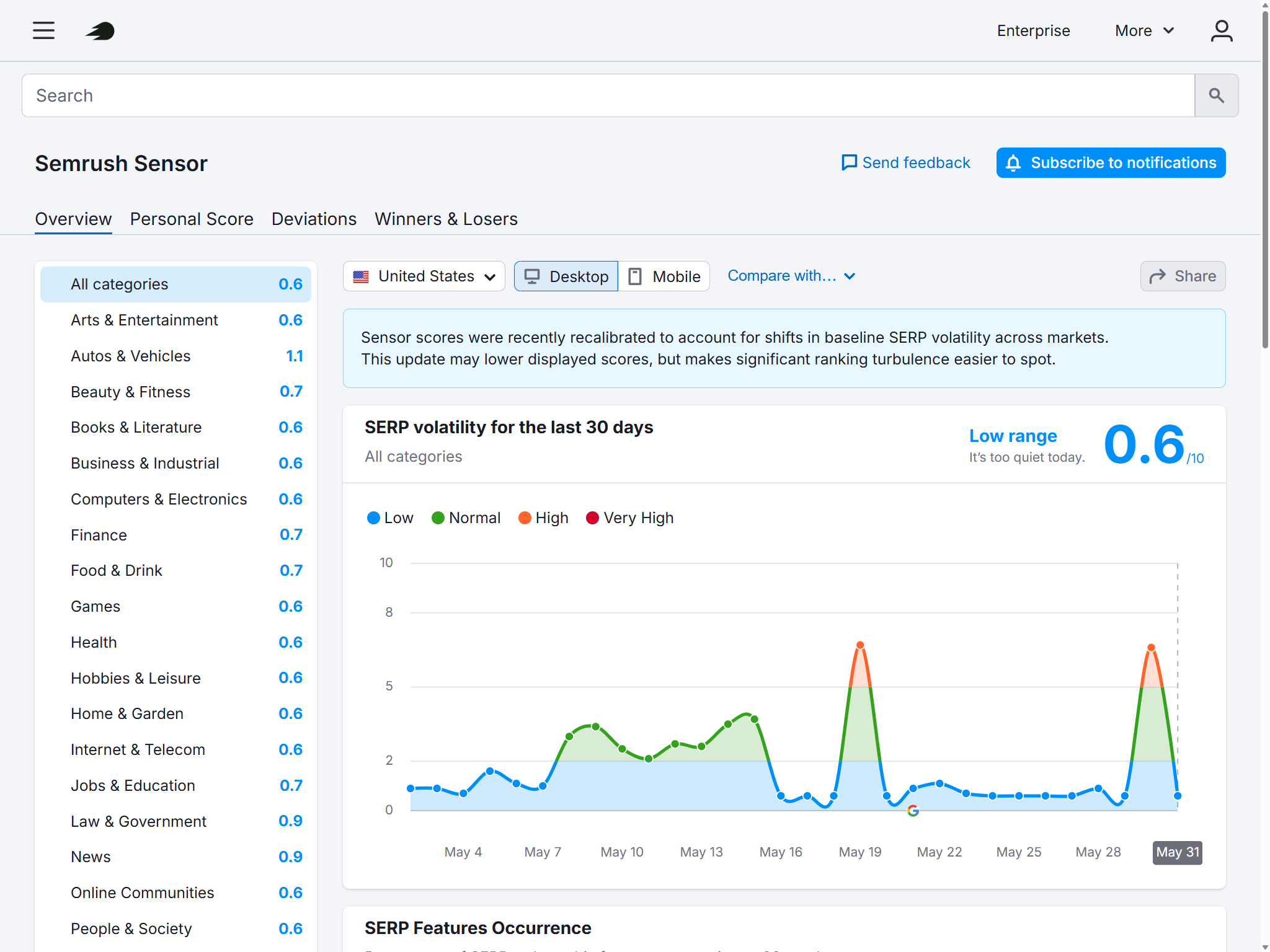
Reporting on the update in SEO Roundtable, Barry Schwartz says the May 2026 Core Update seems to have hit hard on May 30th with SERP tracking tools – Semrush Sensor in particular – showing a lot of volatility. If you have seen changes in ranking between May 21st and June 2nd, it is probable that your site was impacted.
New AI features in Google search results
Google used two events in May – Google I/O and Google Marketing Live – to make major announcements about new features in Google including the biggest change to the search box in 25 years.
This big change is the Intelligent Search Box. The expanded search box encourages users to ask longer questions and gives AI-powered suggestions that go well beyond autosuggest. As with other AI-generated responses, there is the fear that this feature will take users further away from the traditional blue links and make it less likely that they will click on links to external (i.e. your) websites.
Other news from Google relating to Google Search was
- Google’s Universal Cart is arriving in Google Search, Gemini, YouTube and Gmail. This shopping cart will allow clients to add products from multiple retailers from Shopping listings without having to go the retailers’ websites. It will launch in the US this summer.
- Google Search Agents will allow users to create AI agents from the search box. The first iteration of this new feature will allow users to create information alerts asking Google to send notifications when it discovers information corresponding to your search in the future (the example given by Google is for apartment hunting, you can tell Google your requirements and you will get alerts when suitable listings are published online).
- Booking capabilities have also been expanded with the addition of new categories that you can Ask Google to call using AI.
Watch this presentation from Google to see the new features in action.
For a more profound dive into the future of Google with AI, you may be interested in listening to episode 109 of the Search Off The Record podcast . In this episode Martin Splitt speaks with Nikola Todorovic (director of Software Engineering at Google Search) about how AI is changing Google Search.
Google’s guide to AEO/GEO
On May 15th, Google published the guide Optimizing your website for generative AI features on Google Search on Google Search Central. This was accompanied by a post written by John Mueller who said it contained:
- Guidance on the importance of providing valuable, unique, non-commodity content
- Tips about providing local, shopping, image, and video content
- Myth-busting common “AEO/GEO” misconceptions
- Initial guidance related to AI agents, a quickly emerging and evolving space
- Information about why SEO best practices remain relevant and foundational to success with our generative AI features
The guide insists on the fact that SEO (Search Engine Optimization) is still relevant for generative AI search and says that for Google, the terms “AEO” (Answer Engine Optimization) and “GEO’ (Generative Engine Optimization) are not necessary. Leading many to claim that “Google says GEO is dead”. Which is not strictly true, but it makes for good headlines 😊
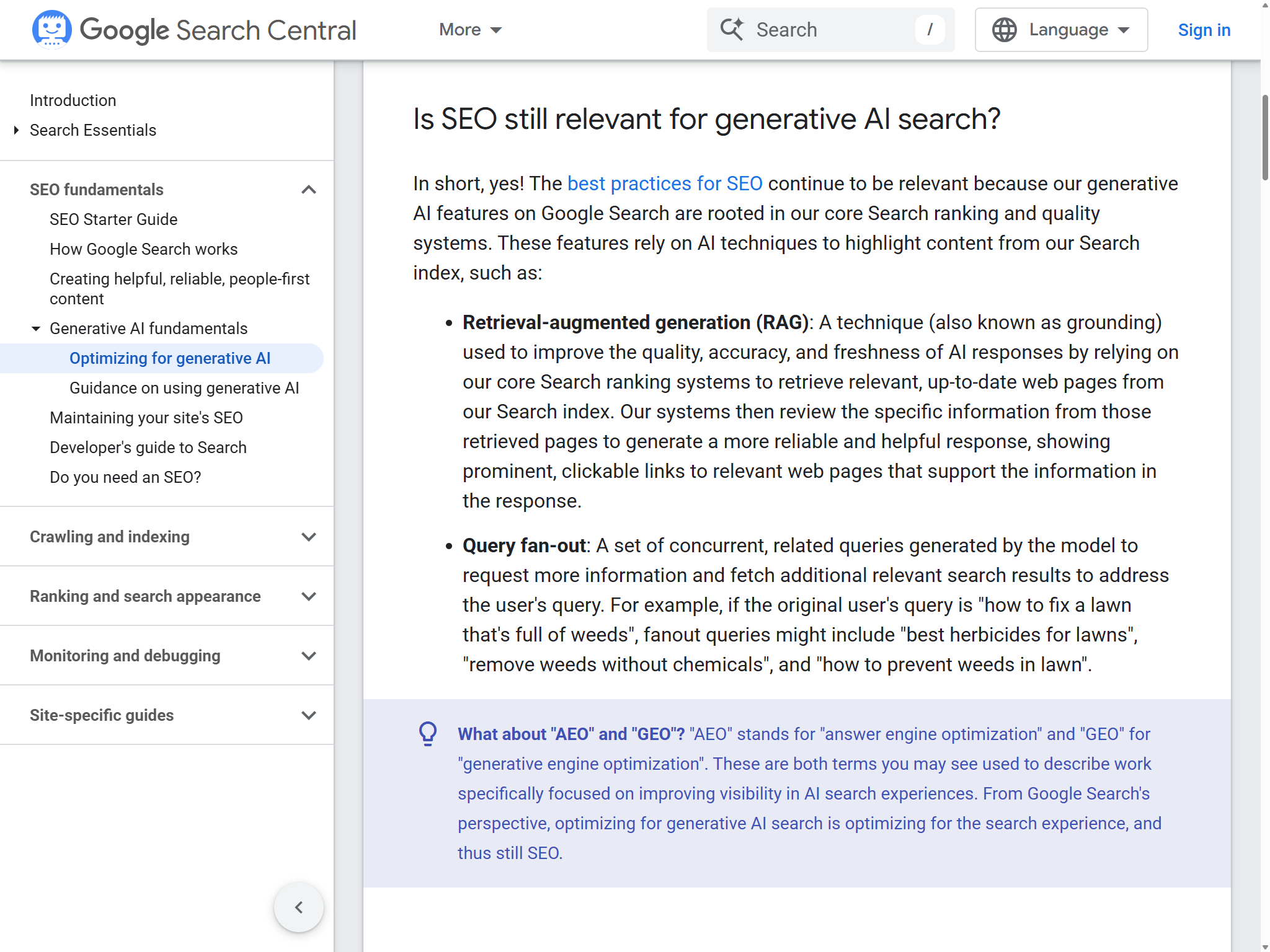
The myth-busting section of the guide deals with prominent hacks given on the internet. The guide says:
- llms.txt files and markdown are not necessary (although Google has also recently added a requirement for llms.txt to Lighthouse Agentic browsing audits – see below)
- Site owners don’t need to write in a specific way for AI. Chunking content is not relevant.
- Spam policies apply to AI generated search results too and inauthentic mentions of your brand, like inauthentic backlinks, are spam.
- Structured data is not required for AI specifically, but it remains a good idea as part of an overall SEO strategy
Dixon Jones, from AEO tool Waikay, gave a critical analysis of the guide on LinkedIn. He claimed it wasn’t so much a technical document, but part of a strategy by Google to keep website owners in the dark about how AI works. He says it is very unlikely that AI tools ignore structured data for example.
Lily Ray thinks Google’s new guide looks a lot like her article AI search is booming, but SEO is still not dead, published on Search Engine Land in July last year.
Getting ready for the Agentic Era
The guide “Optimizing your website for generative AI features on Google Search” mentioned above, ends with an invitation to explore “agentic experiences” if you have extra time to do so. This links through the Web.dev resource Build agent-friendly websites published in April.
Many feel that AI agents will play a very important role in the future of the web, so starting to understand what it is all about is important. At SEOPress we have pressed forward with the addition of Agent Readiness features for WordPress to our plugin following Google’s guidelines. From version 9.8, SEOPress PRO users can toggle on this feature to make sure that agents from tools like ChatGPT, Claude, Perplexity, and Google AI Overviews can find, understand and cite your content.
Agent readiness testing is coming to Google Chrome Lighthouse and Page Speed Insights (it’s already available in the pr-release version of Chrome, Chrome Canary). You can also use the tool Cloudflare tool isitagentready.com to measure the agent-readiness of your site.
In contradiction to Google Search Central’s advice on AI SEO, the Google Lighthouse Agentic Readiness report check for the llms.txt file. Suggesting that this file is important for AI agents and that agents are not considered as part of SEO by Google.
Google adds preferred sources to AI Overviews
Announced on May 27th via a new documentation entitled Help your readers find your site through preferred sources in Google Search new document, Google upgraded their Preferred Source feature to make it useful for more websites. Initially released as a way of choosing preferred news sites for Google News, Preferred Sources now also impacts sources used by AI Overviews and AI Mode. Getting users to choose your site as a preferred source increases the chance of it featuring in search results. It’s an SEO quick win.
To get users to add you as a preferred source, you simply need to get them to click on a link like this: https://www.google.com/preferences/source?q=seopress.org (replacing seopress.org with your domain name).
To help make those links more attractive, Google has provided button images in 16 languages that you can add as CTAs (Call-To-Action) to your website. Keep your eyes open for a new feature in SEOPress to handle Preferred Sources for you.