AI has radically changed search and SEO. Since launching 2 years ago, Google’s AI Overviews now has over 2.5 billion monthly users worldwide and it continued to improve and expand in August. While SEO has to adapt to take into account this new type of visibility, AI can also be a great ally for getting SEO jobs done. Used well, AI assistants (like ours) can help site owners analyze data faster, automate repetitive tasks and improve product information. As AI is accepted as a normal part of search results, using AI for SEO will also become the norm.
But AI does not remove the need to understand SEO. AI can accelerate SEO work, but it can also accelerate SEO mistakes. Major changes to URLs, site structure, content strategy, redirects, or technical setup should still be guided by human SEO knowledge, not by blind confidence in a prompt. Google’s August Spam Update also warns us that using AI to manipulate search results is not a good long-term strategy. Be careful of advice that sounds like cheating whether it comes from a human or a machine !
Google August Spam Update
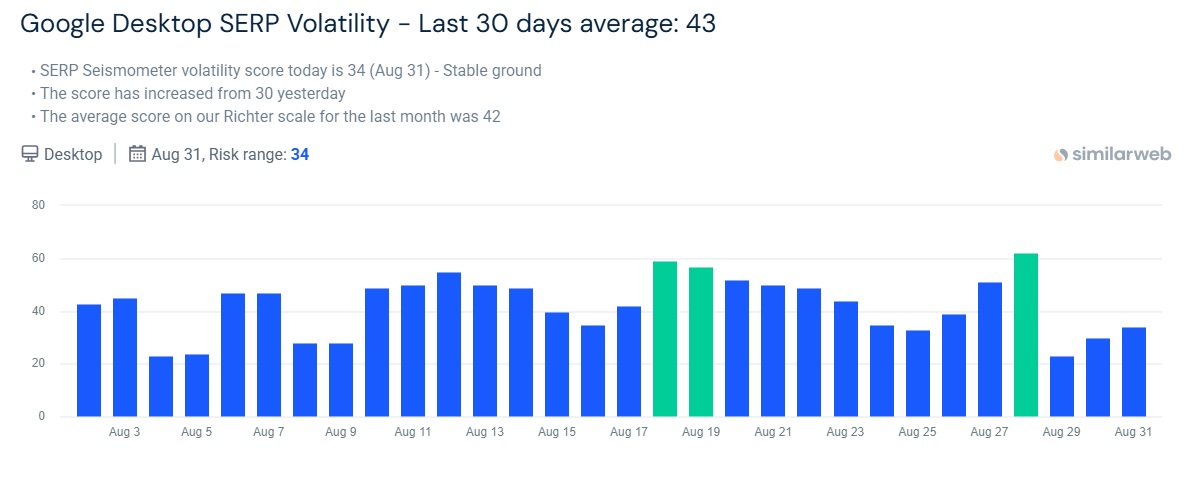
Google launched a Spam Update on August 18th, and it rolled out in 3 days, finishing on August 21st. Tools measuring the volatility of Google search results showed increased activity on August 18th and 19th. If your ranking dropped on these two dates, you may well have been impacted by the update.
The official announcement on LinkedIn read “Today we released the August 2026 spam update to Google Search. This is a normal Spam Update, and it will roll out for all languages and locations. The rollout may take a few days to complete. More information about spam updates can be found at https://developers.google.com/search/docs/appearance/spam-updates”. This was identical to the announcement made in June for the previous Spam Update. It gives no information on the specific type of spam Google targeted.
A Spam Update refers to an update in Google’s ranking algorithm that affects how it detects and eliminates pages that do not respect Google’s spam policies (it finds and punishes cheats by dropping them from ranking). There are 16 types of spam detailed in the policies and, in theory, a single Spam Update could deal with one or many policies.
Writing for Search Engine Journal, Roger Montti says that Reports indicate that Google’s Spam Update focused on SEO AI content. He references a scientific paper published by Google called “Scalable Detection of Adversarial Synthetic Slop and Coordinated Media Abuse: A LoRA-Enabled Multimodal Defense System” and he thinks that the system described in this paper may have been implemented during the update. This would have the intention of detecting and eliminating mass-produced AI content and not AI content per se.
On the subject of AI detection, Anthropic announced on August 10th that its AI tool, Claude, now adds a watermark to any text and images it produces, making it easy to detect as AI-generated. This is in respect of the European Union’s AI Act’s Article 50(2) Code of Practice on Transparency of AI-Generated Content. Although the methods for recognizing these watermarks have not been made publicly available yet, it is not impossible to imagine that Google will be one of the first parties to get access to detection tools and may use them to detect spam. See our article on AI detection in search engines from 2024 for more detail on this subject.
More volatility in Google search results
We often spot volatility in Google’s search results outside the start and end dates of official updates. Looking at reports from search result tracking tools (like Similarweb featured below), we can see peaks of volatility in August during the Spam Update, but also early August and around August 28th. Barry Schwartz, a journalist specializing in SEO, detected significant volatility on August 1st to 3rd, August 13th and August 26th.
He speculates that this could be a new ranking update, tremors linked to previous updates or an effect of Google showing less PDF files in results (this has been mentioned by Savanna Gray on LinkedIn).
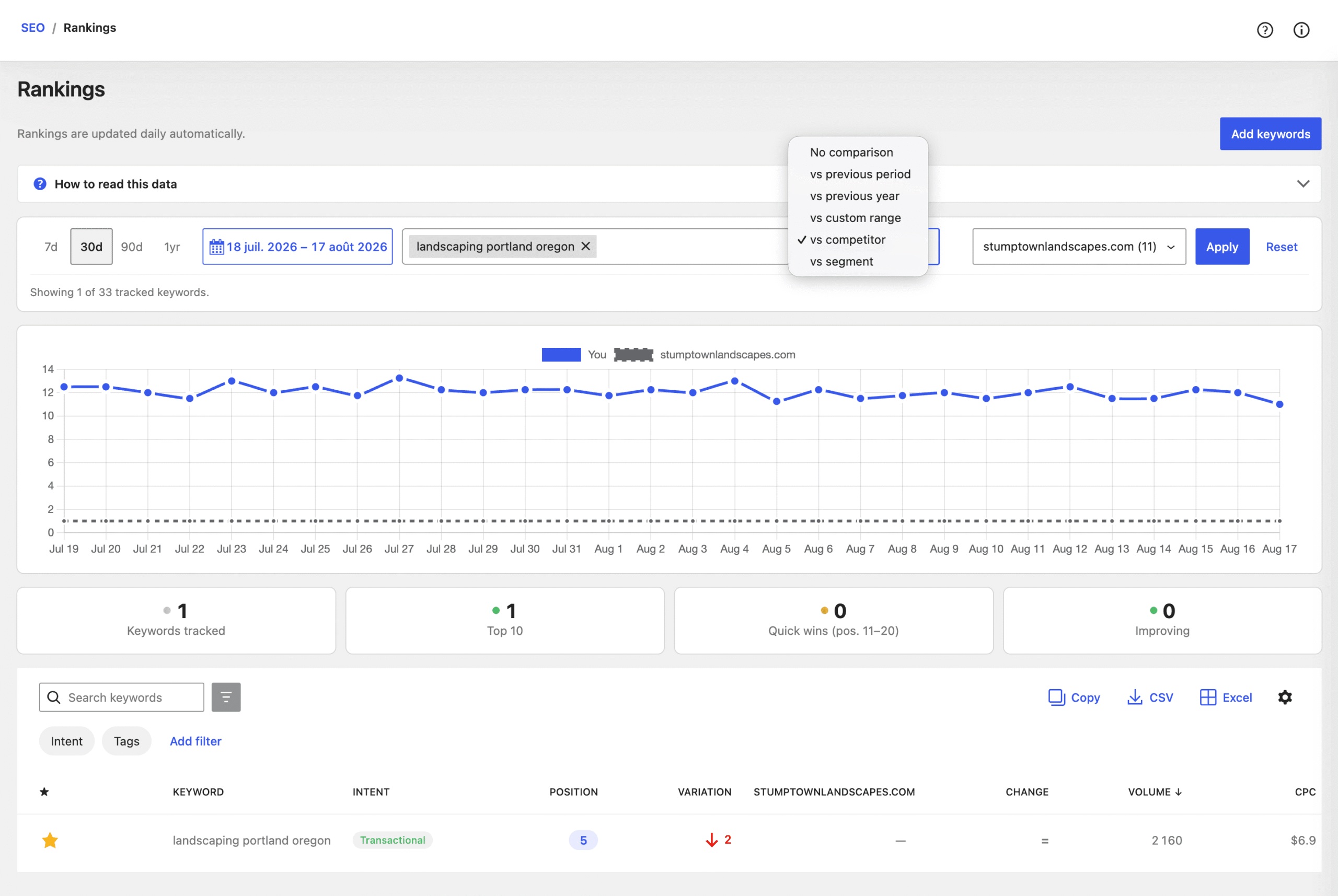
If you notice a drop in your ranking through SEOPress Insights reports, it is interesting to see if this corresponds to a general trend or if it is specific to your site. In our experience, many ranking problems for small businesses are caused by changes made to the site and not a Google update.
The state of SEO through the eyes of a freelance SEO
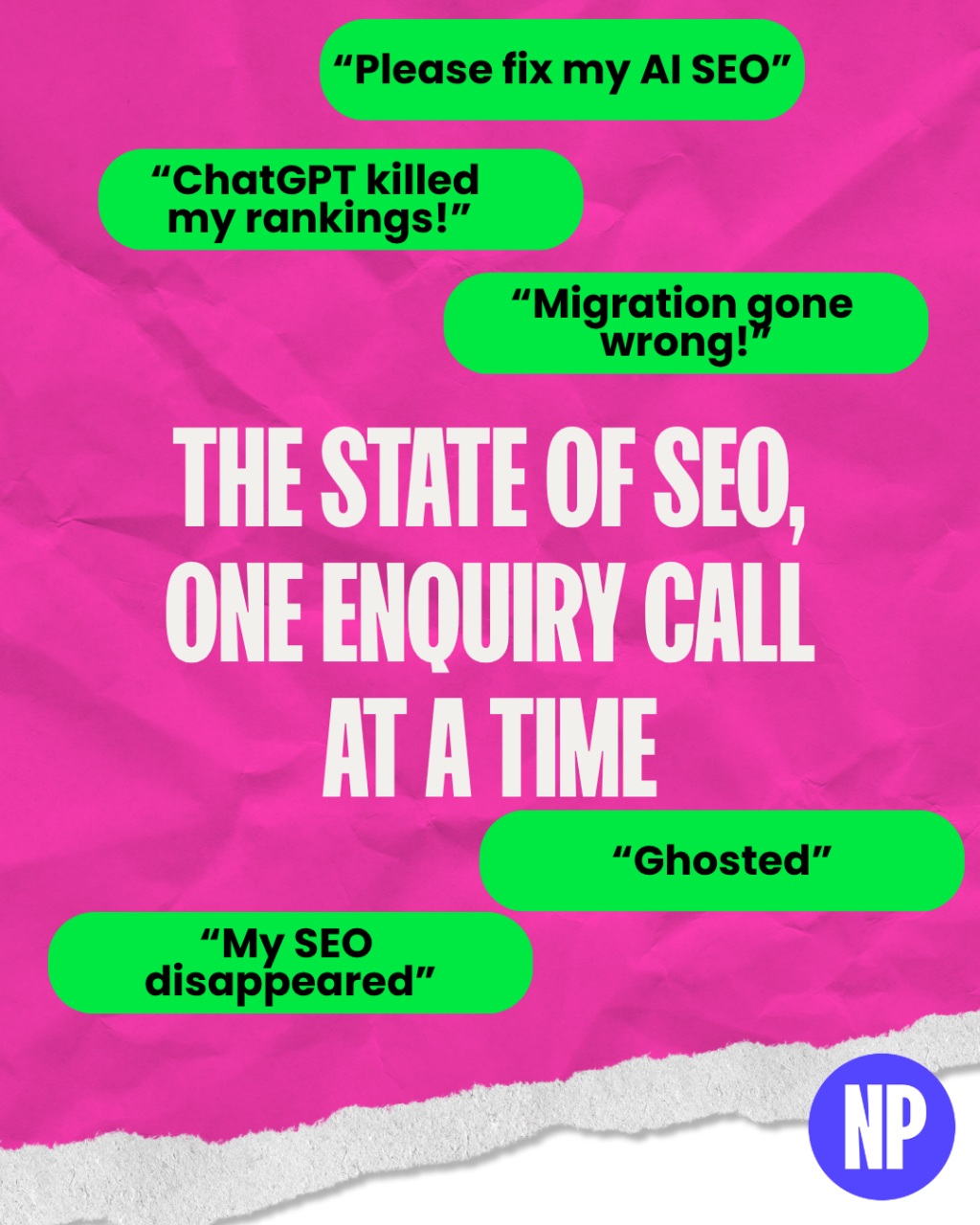
Throughout the month of August, Nikki Pilkington, a freelance SEO based in the UK, has been sharing the details of 17 enquiry calls she received in July 2026 on LinkedIn.
At the time of writing, Nikki has published details of 11 calls. Although it is not a big sample, common themes are emerging. Several businesses lost rankings, traffic and enquiries after website redesigns, migrations or large-scale content changes. In some cases, those changes were made following advice from AI tools. In one case a site was rebuilt entirely using AI, without a CMS like WordPress.
Web professionals may find these stories sadly familiar and very topical. For website owners, they are a useful reminder that poor decisions around SEO (URLs, redirects, site structure and content) can have terrible real-life consequences, whether they are implemented by humans or AI.
Here are the direct links to individual LinkedIn posts :
- #1 The “ChatGPT-told-me-to” disaster
- #2 The “Competitor conquest” – too much spammy content
- #3 The “Vibe Coded” redesign loop
- #4 The “Just Changed the Theme” Redesign
- #5 The “I Only need SEO” Redesign
- #6 The “I’m not a bank” rejection
- #7 The “You don’t know what you don’t know” enquiry
- #8 The “I’ll just use better prompts” enquiry
- #9 The “We rebuilt and vanished from Google” enquiry
- #10 The “Get a quote then ghost” enquiry
- #11 The “My Copyrwiter recommended you” enquiry which turns out to be a good example of how website migrations can be handled
Stories of AI negatively impacting SEO should not put website owners off using AI for SEO. AI is an amazing tool for carrying out repetitive SEO tasks quicker than you can do manually. SEOPress uses the WordPress Abilities API for its AI integrations. Rather than giving an AI tool unrestricted access to your WordPress site, SEOPress exposes specific SEO actions through WordPress with permission and safeguards around what the agent can do.
The SEOPress AI Agent can therefore help analyze and update SEO data while you remain in control of the access you give it. AI can speed up the work, but important SEO decisions still need human oversight.
New Google AI search features
In August, Google continued to upgrade its AI features in search results as they become increasingly used. On average, Google responds with an AI-generated response for over 30 % of queries and AI Overviews has over 2.5 billion monthly users worldwide.
There is a fear that the popularity of AI-generated responses will eventually lead to the disappearance of Google’s traditional 10 blue links. Barry Schwartz shared reports, and a subsequent confirmation from Google, that AI Overviews can be shown expanded in search results, pushing the 10 blue links further down the page.
New AI features were also announced by Google on August 19th and August 27th.
The August 19th announcement was for 5 new learning tools :
- Interactive visuals
- Practice quizzes
- Lens learning experience
- Notebooks
- Custom files
The August 27th announcement was about new travel features :
- Flight price tracking
- Calculating cost in points or miles
- AI Mode booking
Google also added a note to the article Introducing Search Generative AI performance reports in Search Console to say that as of August 31st, the new features are available worldwide for all websites. As well as providing statistics on a site’s visibility in AI, Google also gives the possibility for sites to opt out of AI Overviews and AI Mode via the new Search generative AI control.
Microsoft help optimize for AI powered Shopping
A new article, How businesses win when AI does the shopping, published by Microsoft on August 21st suggests that the rise of AI-powered shopping is the biggest change in digital commerce since mobile.
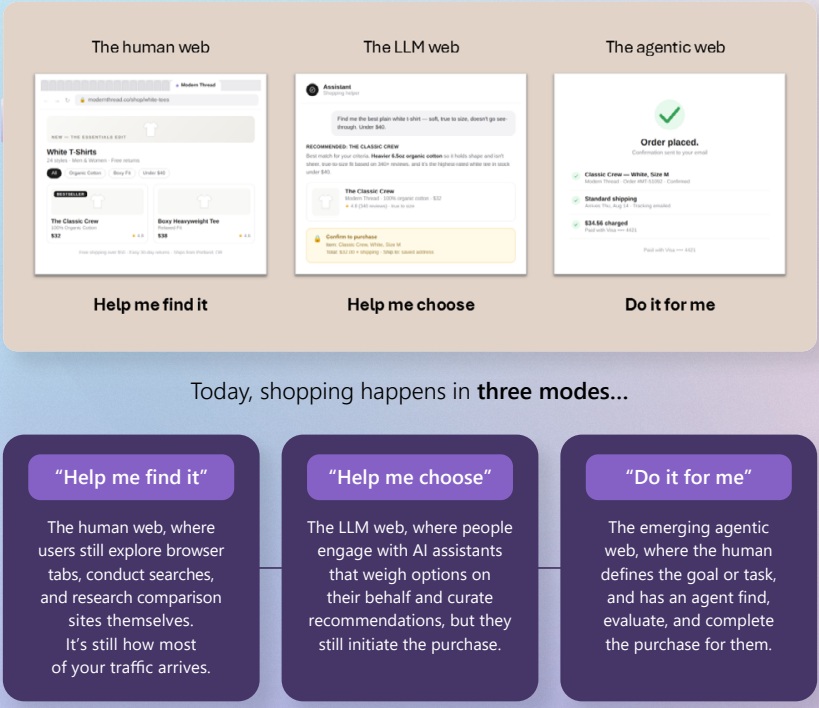
AI-powered shopping could mean humans asking AI agents to find, evaluate and complete online purchases, but it also means humans using AI to help them find and choose products prior to purchase online or offline. This is hardly the future, “AI and AI agents influenced 20% of all retail sales globally over the 2025 holiday window, roughly $262 billion in sales” says the article.
Author Shirley Chen insists that having complete, structured product data is already the most valuable marketing asset an ecommerce site can have in 2026. But there are other steps that sites she says sites should activate to ensure that they are ready for AI shopping and the article links through to a 90-day activation roadmap, to get discovered, be chosen and help understand results.