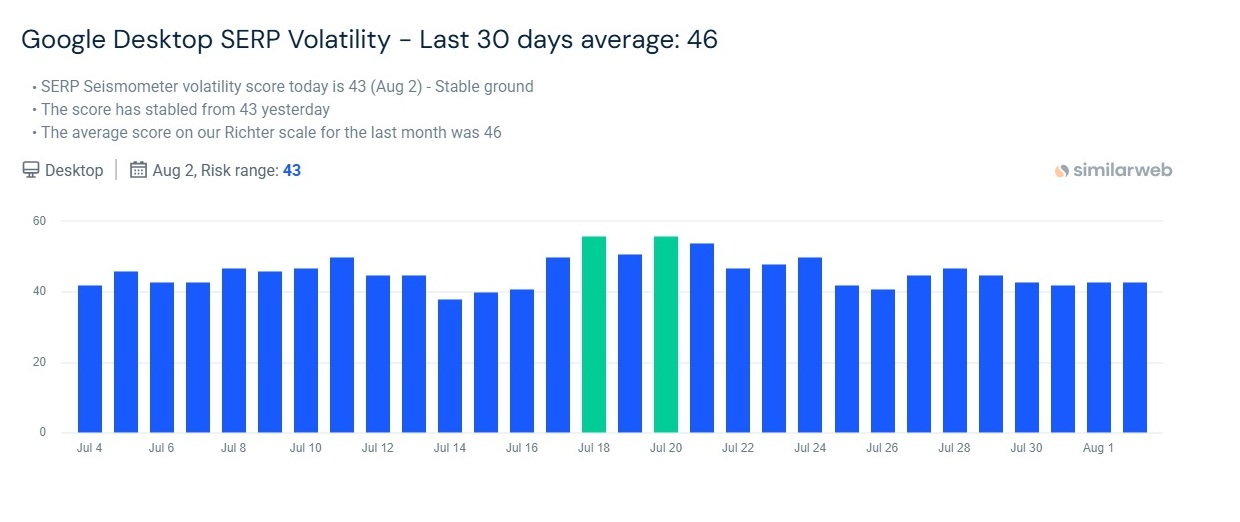
The hot summer of Google updates we predicted last month didn’t materialize in July. There were no official updates and there was very little volatility recorded in search results – unless you are in France where Google users suddenly discovered AI Overviews and AI Mode for the first time on July 23rd. The arrival of AI features in France also coincided with a wider roll-out of controls to let sites opt-out of AI features.
As detailed by the reports and studies below, Google continues to dominate the search market despite the increasing challenge from AI tools like ChatGPT, Claude and Perplexity. Google Vice-president Nick Fox said that the search engine recorded its all-time usage record during the World Cup in July and Google’s Q2 Earnings reported a total revenue of $119.8 billion, up 24% from last year. Google seems to be thriving in a competitive market.
Q2 State of Search report shows
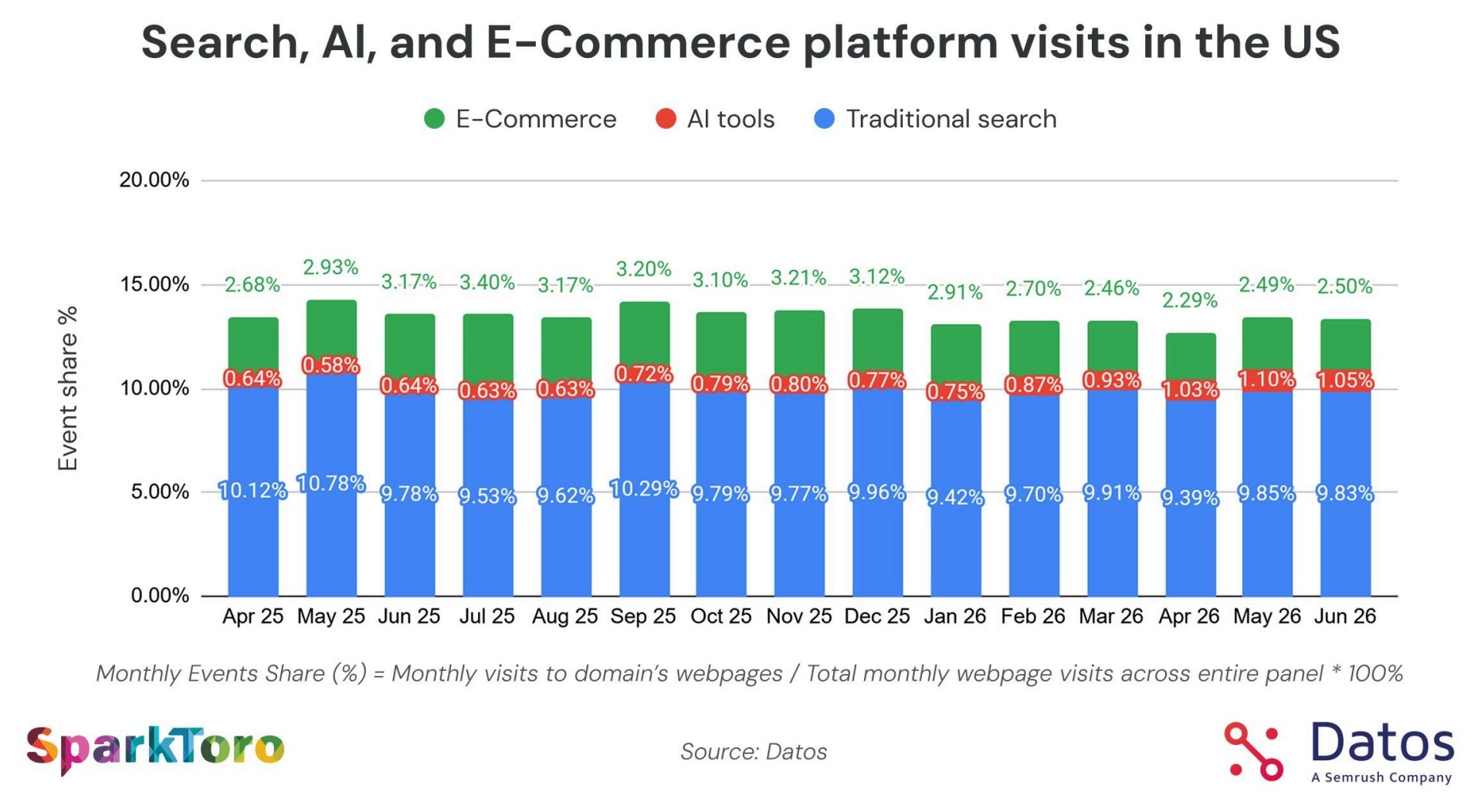
The Q2 State of Search report published by Datos and Sparktoro on July 27th gives some important insights into the use of search tools in the US and Europe. They report on data collected from millions of desktop users in the USA and Europe from April to June 2026. As with previous State of Search reports, this shows that traditional search engines are used far more often than AI tools (and it is worth remembering that AI tools are used for more than search). In Q2 2026 10.52 % of all website visits in the US were to search engines, compared to 1.83 % for AI tools (and 2.79 % for Ecommerce platforms). AI tool usage increased from the first to the second quarter of 2026 but there is a notable drop from May to June. This drop is also apparent in the European data.
The report also contains expert analysis by Sparktoro’s Rand Fishkin. Rand warned us about the rise of zero-click searches in Google back in 2019. On data collected in June 2026, he highlights the record low number of clicks to non-Google-owned websites as a number “that should frustrate every proponent of the open web”. Only 40.7% of searches lead to a non-Google property (another record number is that 20.4% of searches lead to a Google-owned property such as YouTube, Maps, Weather, etc.). The top 3 destinations from search engines in the US are YouTube, Reddit and Amazon. The top 3 destinations from AI tools are Google, YouTube and Microsoft.
As for data on AI usage, the Datos report also shows that ChatGPT is losing ground to Claude and Gemini in the US and Europe. 36.05% of the US user base visited ChatGPT in June, compared to 19.53% for Gemini and 11.51% for Claude.
2026 Generative AI Landscape
Another report released in July (and also featuring Rand Fishkin!) was SimilarWeb’s 2026 Generative AI Landscape Report. This showed some interesting findings about AI tools, including these key metrics:
- 5 billion generative AI users in the World
- 4 billion generative AI app downloads in the World
- 50 % of generative AI users worldwide are aged 18 to 34
- 96% of ChatGPT users also use Google worldwide
- 26% of ChatGPT chats contain ads on US desktop
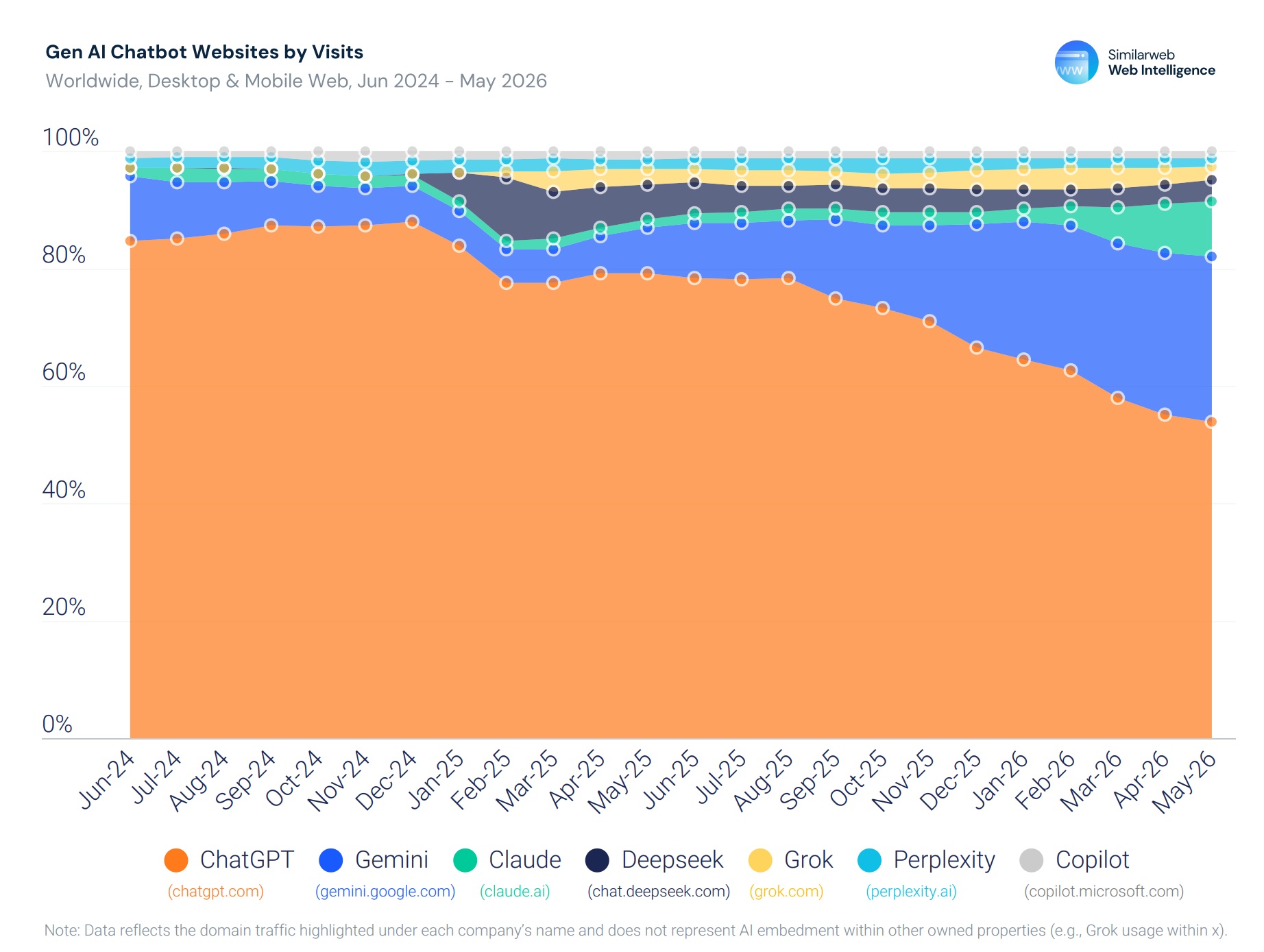
This report also has its own take on the market share between AI tools. Showing the declining visits to ChatGPT and increasing visits to Claude, Gemini and even Grok. In the detail, though, we see that many people use ChatGPT, Claude and Gemini. They are not using one tool exclusively. 95% of ChatGPT users also use Google. Claude is the tool that has increased its traffic the most since the beginning of the year.
This report also gave the much-shared statistic that AI Overviews are now visible for over 40 % of searches in Google, up from 15% in January 2025. AI Mode use is steadily increasing too. Up to 320 million visits in March 2026.
Proof that AI-generated content can rank in search results
On July 27th Ryan Law of Ahrefs shared the results of a study he performed into the indexation of AI-generated content by Google. The title of his article gives away the results: Google Doesn’t Punish AI Content; It Punishes Bad Content. The analysis of data using Ahrefs AI Content Level score shows that 5.3% of top-ranking pages in his sample were 100% AI-generated. For Ryan this proves that SEOs should not be frightened of using AI content creation but should remain wary of the quality of content that AI creates.
There is a strong correlation between AI generated content and poor performance. Ryan warns that AI used basically will often generate content that repeats common knowledge, does not include internal and external links, has a tedious style of copywriting and can still contain mistakes and gross inaccuracies.
He shares findings by Lily Ray and Glen Gabe that show AI-generated sites can peak and then crash spectacularly in ranking creating a “mount AI” graph when looking at traffic over time. Sites like this actually see pages deindexed by Google rather than simply dropping in ranking.
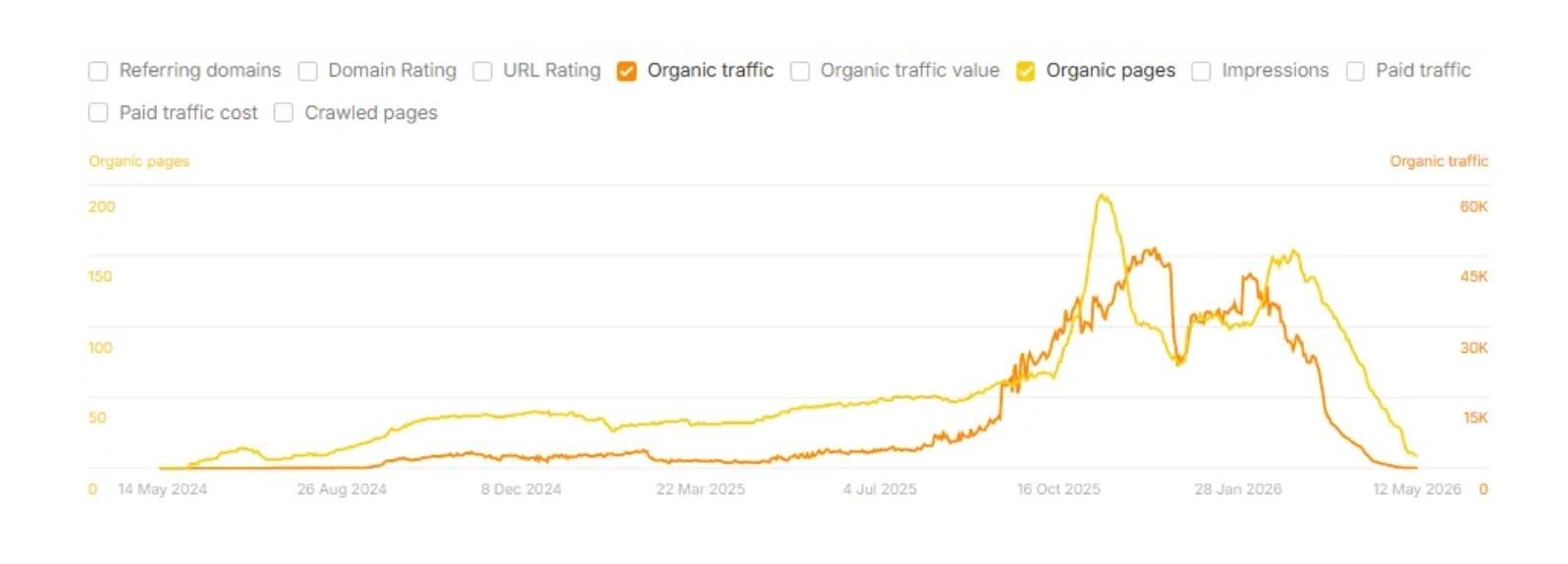
Google’s John Mueller also shared a similar scenario in a recent Off The Record Podcast released on July 16th. Talking about solving “Crawled – currently not indexed” issues in Google Search Console, he says the cause is “maybe most of your website is AI-generated”. He goes on to describe how people (and Google) can see that the content is AI-generated and does offer anything different from lots of other content on the web. In which case Google will ask “Why would we add it to the index” and a page that was originally indexed may be removed.
Google Search Console adds social media properties
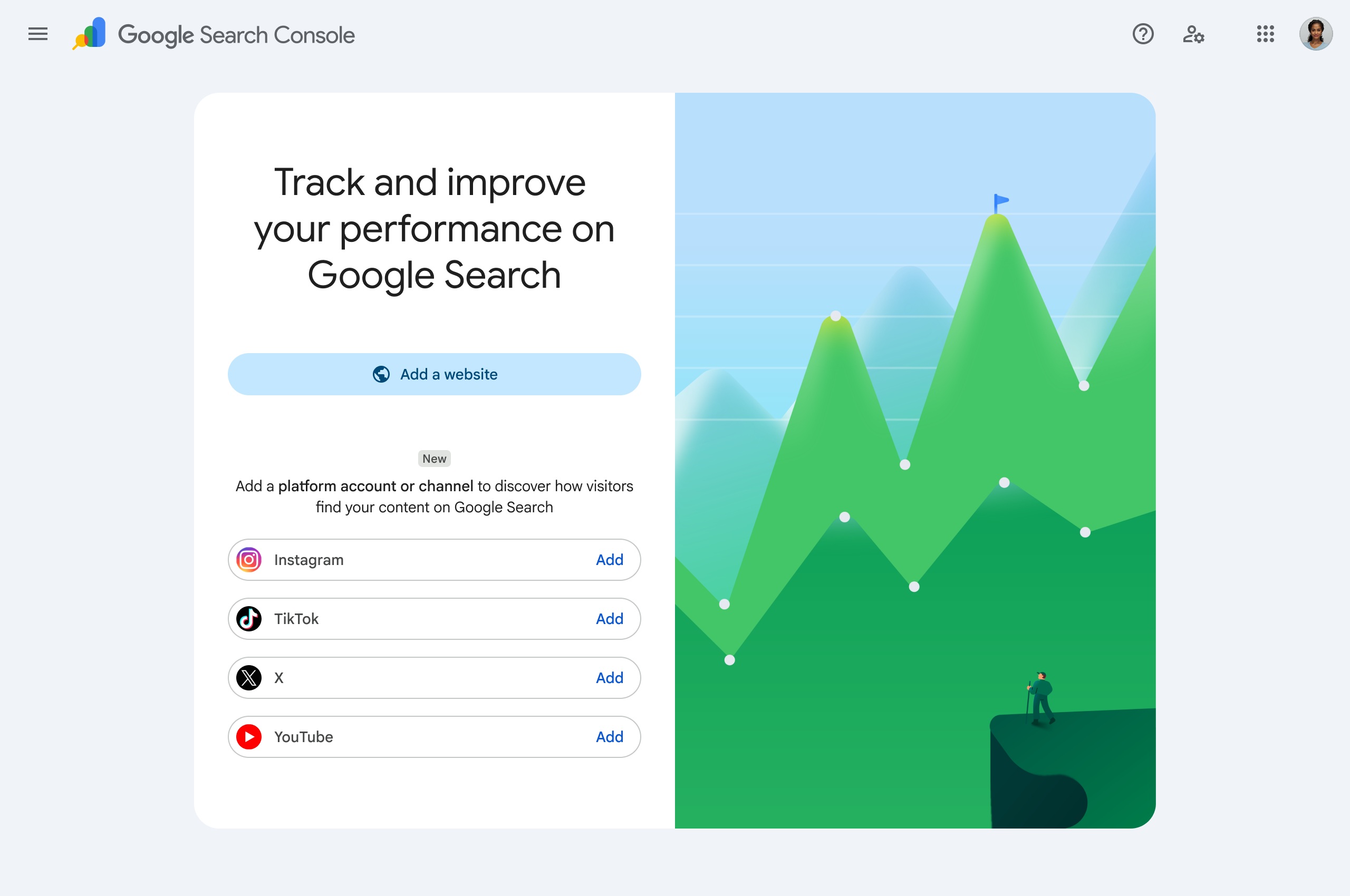
On July 7th, Google announced the global launch of Platform Properties for Google Search Console. This new feature allows you to add social networks to Google Search Console and, see performance metrics such as impressions and clicks for these properties.
Each network added creates a property alongside your website property in Google Search Console. You can currently add Instagram, TikTok, X, and YouTube accounts. Facebook and LinkedIn are not yet supported.
To add a social network property to Google Search Console:
- Open Search Console.
- Using the property selector drop-down at the top-left of the screen and click “Add a property.”
- Select one of the four available platforms: Instagram, TikTok, X, YouTube
- Follow the onscreen verification steps to securely authorize the connection
- Repeat for each social network you want to add